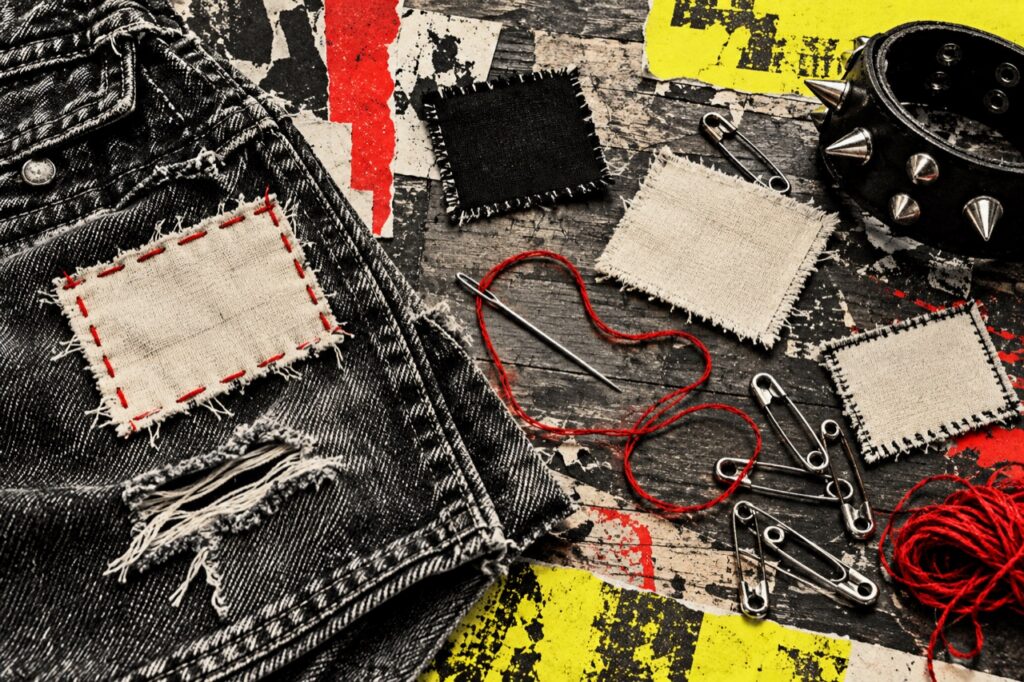
Punk rock fashion turns everyday clothes into something their wearer has a hand in making: patched, cut, drawn on, repaired or deliberately rearranged. Its history connects music scenes with experiments in dress, rather than one outfit everyone is required to copy.
This guide looks at the documented relationship between DIY clothing, London’s boutiques and punk’s later move into high fashion. The practical ideas at the end are suggestions for making something personal, not rules for proving that you belong.
Where did punk fashion come from?
A useful starting point is the exchange between music, clubs, clothing and self-presentation in 1970s New York and London. There is no need to compress every scene into a single inventor. The Metropolitan Museum of Art’s 2013 exhibition, PUNK: Chaos to Couture, used both cities to frame its account of punk’s emergence, then traced how designers borrowed the movement’s visual language.
That is an exhibition about fashion’s relationship to punk, not a complete history of every local scene. It is most useful when read alongside specific garments, bands and places, rather than as a universal dress code.
Vivienne Westwood, Malcolm McLaren and 430 King’s Road
London Museum’s history of the King’s Road shop gives the London story a concrete address. Westwood and McLaren began selling records and memorabilia at 430 King’s Road in 1971. The business evolved through different identities, including SEX in 1974 and Seditionaries in 1976.
The museum documents customised T-shirts and combinations of leather, zips, tartan, straps and distressed fabric. It also notes that many punks could not afford the shop’s clothes and made their own. That detail matters: the famous boutique and the homemade response belong in the same history.
A designer’s contribution is worth understanding without turning an expensive purchase into an entry requirement. Looking at how a garment was altered can teach more than searching for an exact branded replacement.
What makes the DIY approach distinctive?
The Met grouped its exploration around hardware, bricolage, graffiti and agitprop, and destruction. Think of these as ways to examine an object: what was attached, repurposed, written on or taken apart? They help explain why a modified garment can communicate differently from an untouched one.
For a personal project, that could mean stitching a scrap over a worn area, drawing an image of your own, or moving a patch as your interests change. These are contemporary suggestions inspired by the DIY approach, not claims that every punk used the same techniques.
How to make punk style your own without buying a costume
- Begin with something you already wear. Choose one change that makes it more useful or expressive.
- Make the message yours. Use an original drawing or a band patch you actually want to wear; no collection of symbols proves membership.
- Keep it practical. Secure additions and check comfort, sharp edges and freedom of movement before wearing the piece out.
- Let it develop. Repairing or changing a garment can be part of its story. You do not need to finish a complete look in one shopping trip.
Does punk have one correct uniform?
Our view: no. The most useful lesson here is participation: making decisions about what you wear rather than letting a checklist make them for you. A museum object or a famous stage look can provide a starting point without becoming a standard that excludes someone else.
Connect the clothes to the music with our post-punk listening guide and women in punk feature. For current releases and independent-label coverage, visit Punk Rock News.
Substantively revised October 28, 2026, with museum sources, clearer historical scope and practical DIY suggestions. Original publication date retained.